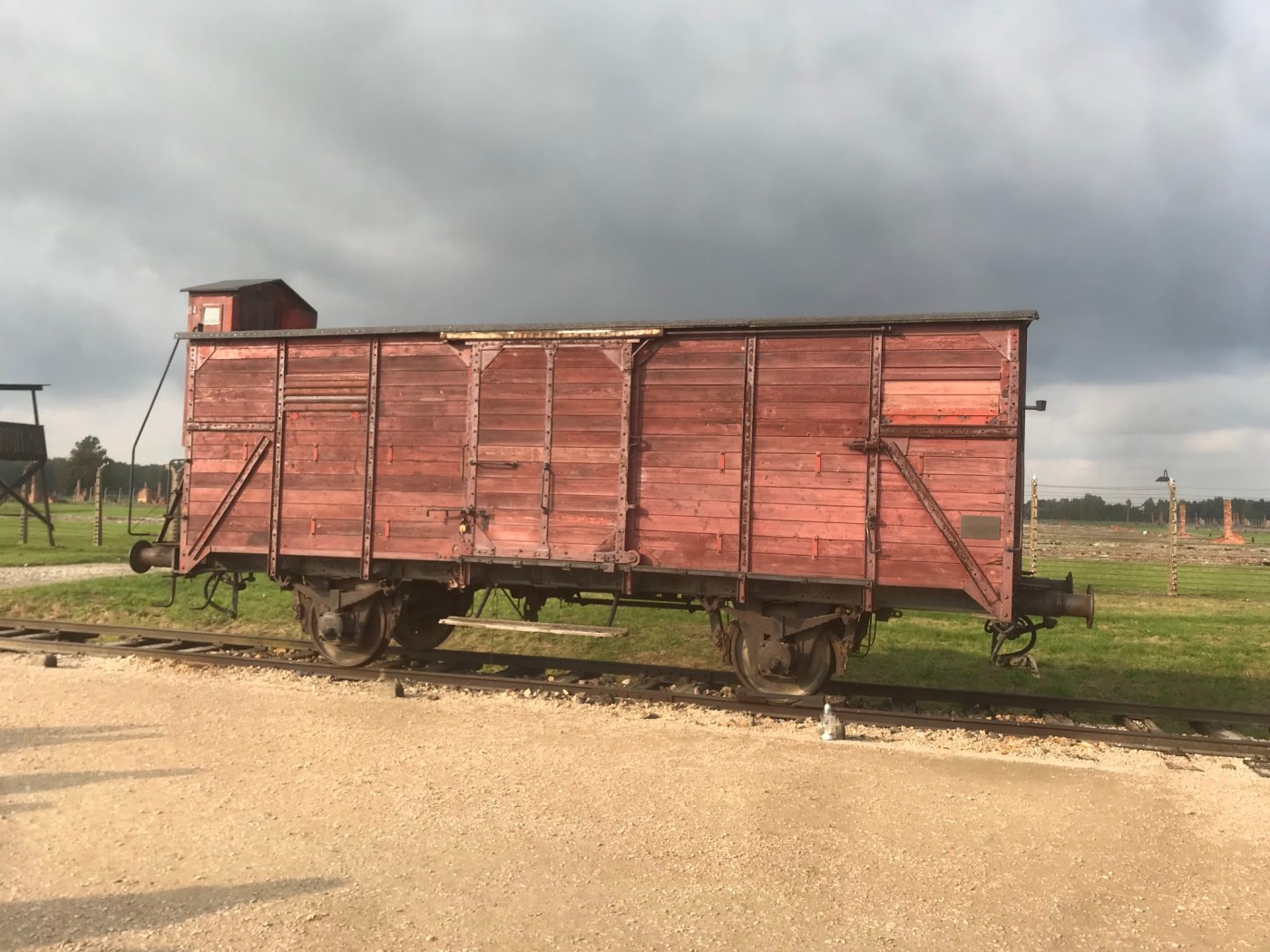
Driving from Krakow to Auschwitz in a minivan is surreal enough by itself. I booked the trip through an app that only had 5 ratings. While I was waiting to be picked up, I was gently reminded of a film named ‘Hostel’, in which people are kidnapped into being trafficked. (My brain is always happy to provide such useful information in situations like this.) A van approaches, with no windows in the back. Should I just get in, or do I send a picture of the license plate to a friend first? Oh, never mind, the van just drove passed me. The next van is a police-riot-van. This one also drives by without picking me up. A pedestrian stops and looks at me. He looks at the building I’m staying in and looks at me again. “Are you going to Auschwitz?” “Yes.” “Ok, I’m looking for John…” “Johan?” “Yes, Johan Menheere!” “Yes, that’s me.” “Ok, nice, follow me please.” I wonder… “Are we walking?” Chuckle. “Yes, only for a short while, the car is here.” A few pick-ups later, all the passengers are loaded. An Irishman, married to a British lady, an American couple, (he is in the army, stationed in Italy), an Irish couple, (he works in customer service), and me. Matteo is our driver and a good host.
I try to read during the 65 km trip but change my mind and look at the Polish landscape, the buildings, and compare the differences with home. I still don’t know if Poland is a country similar to Belgium or not. The colours are not the same; it seems the Poles like their houses in pastel colours. Pink, green, blue… Being driven to Auschwitz does something to you, like it or not. I can’t help but think about the millions of people that were driven there and to other places like it against their will. Not in vans but in trains. Not on comfortable seats but standing or sitting on the floor. Not for an hour but for days.
When we arrive at the site, I see hundreds of people like me, going for a visit to this place, this horrible, horrible place. Again, there is an imaginary flashback to the 1940’s. Not hundreds but thousands of people arriving and being forced inside. The tour guide will explain to us later that all personal items were forcefully taken from the prisoners upon arrival. These people were promised a new place of living but could only take one suitcase per person. Naturally, people took their most valuable possessions. But instead of a new place for life, they found a place of death.
The surreal imaginary flashbacks keep happening, maybe intentional, maybe by way of strange coincidence. Before we can enter the grounds, thanks to Covid, we all go through a disinfection-gate where we are sprayed with sanitiser. After this, we are told to put all our personal belongings in a tray, as we go through a metal detector. We get our items back, they didn’t. We were actually sprayed with sanitiser, they were gassed.
It is strange, to walk into buildings where people were brought to be murdered. To see the straw on which they slept. The movie images come to life, and I realise this actually happened. But of course, I already knew it happened, I read the books and heard the stories. And still… only now is it real. It happened. When watching a movie, you see the actors, when reading a book, you imagine the people. But here, looking at the photographs of those people, real people, I see you, I see me, I see them. What struck me was the looks in their eyes. Some were as I had expected: sad eyes, empty eyes, others were brave, fierce, proud, defiant eyes. Some were smiling with sass. As if to say: “You can’t break me with your horror. You can’t get inside of me.” I looked around for fear and hate but didn’t see that. A few of them showed surprise. I must keep thinking about what their looks mean. What were they thinking, were they still thinking or did their faces show a random accidental look?
Again, I think about the films, and as realistic as some of them are, it doesn’t touch me. It’s happening on the screen, so it’s not real, they are actors. None of them feel the boot as it kicks, actors don’t sleep in barracks on the ground when it’s freezing and snowing. I can’t smell the stench of death or can’t even begin to imagine the emotions of a man loading piles of dead bodies into ovens to be burnt. I will never feel the loss, and I hope I will never experience the reality that was theirs.
Our guide made a big point in showing that the people this happened to, were normal people from all over Europe. Men and women, just like you and me. He made a bigger point in showing that the people that did this were also normal people. Men and women, just like you and me. The very first tour guides in Auschwitz, after the war ended, were people that were imprisoned there. They needed to show what can happen, what people are capable of, what we are capable of. If I think that I could never do this, I am fooling myself. I am capable of this, so are you, and by looking at these acts that were committed by human beings, I must realise I need to be saved from the wickedness inside of me, I must kill the me inside that is capable of this. I must let God strip every evil from me and let Him clothe me with more of Him.
“Auschwitz did not suddenly fall from the sky.”
MARIAN TURSKI – Auschwitz survivor
 Recipes of Hope
Leave a comment